


Eco-Friendly Shirts for Brands: 2026 Buying Guide
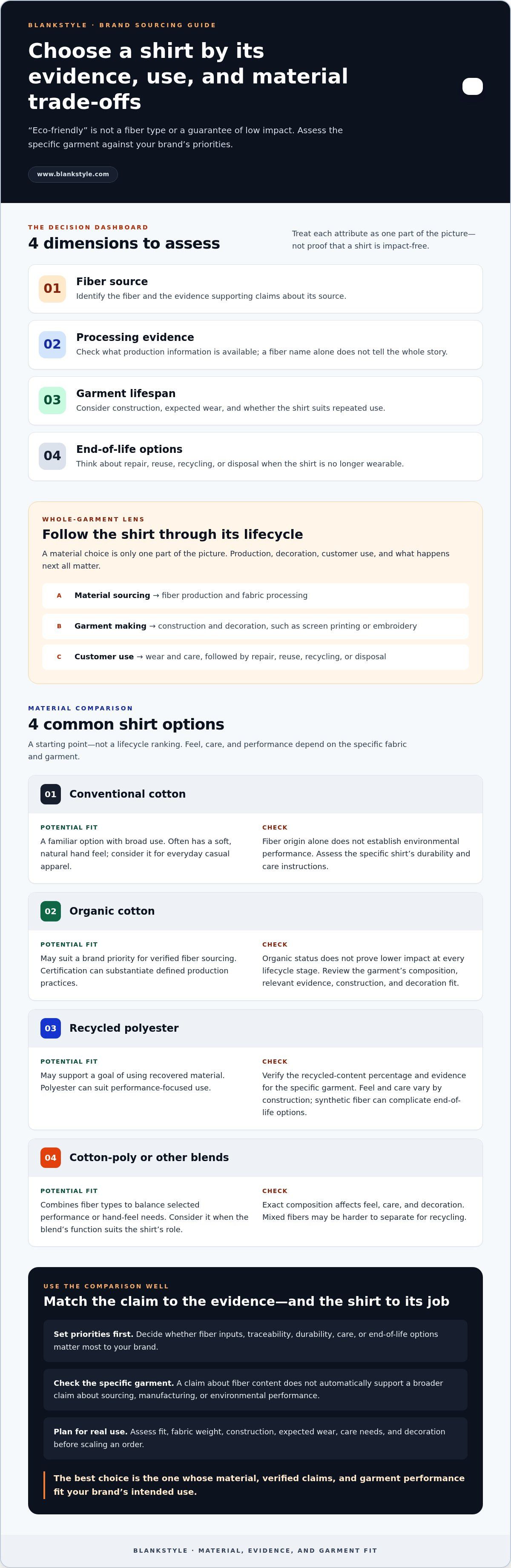
Brands selecting eco-friendly shirts face a practical challenge: fiber names and sustainability labels alone don't guarantee a garment meets environmental priorities. This 2026 guide compares common materials, explains how to verify certifications, and provides a framework for sourcing decisions. Success requires matching environmental claims to documented evidence and assessing fit for intended use.
Key points
- Define "eco-friendly" by weighing fiber, processing evidence, garment lifespan, and end-of-life options. A shirt using recycled fiber doesn't establish how it was dyed, how long it will last, or what happens when discarded—all factors that shape actual environmental impact.
- Match every environmental claim to specific evidence covering that attribute. The guide notes that "a certification supports a specific claim within a defined scope" and doesn't automatically prove lower impact across all production stages.
- Compare materials—conventional cotton, organic cotton, recycled polyester, and blends—against your priorities for feel, care, and intended use. No single fiber works for every brand; recycled polyester may suit performance apparel while certified organic cotton aligns with sourcing-focused goals.
- Assess fit, fabric weight, expected wear, and decoration needs before scaling an order. A lightweight shirt fits warm-weather events while heavier construction suits frequent-use uniforms; durability depends on construction quality, not material name alone.
- Build a sourcing brief recording garment use, material priorities, evidence requirements, and decoration fit. This document keeps product decisions and environmental claims aligned across repeat orders and helps prevent stretching product-level claims into broader promises.
- Review certifications like GOTS, OCS, and GRS to confirm they cover the specific claim and product. OEKO-TEX STANDARD 100 tests for harmful substances but doesn't certify overall sustainability, so certification names aren't interchangeable.
Summarized by MalakyeAI