


How to Get a Company Merch Budget Approved
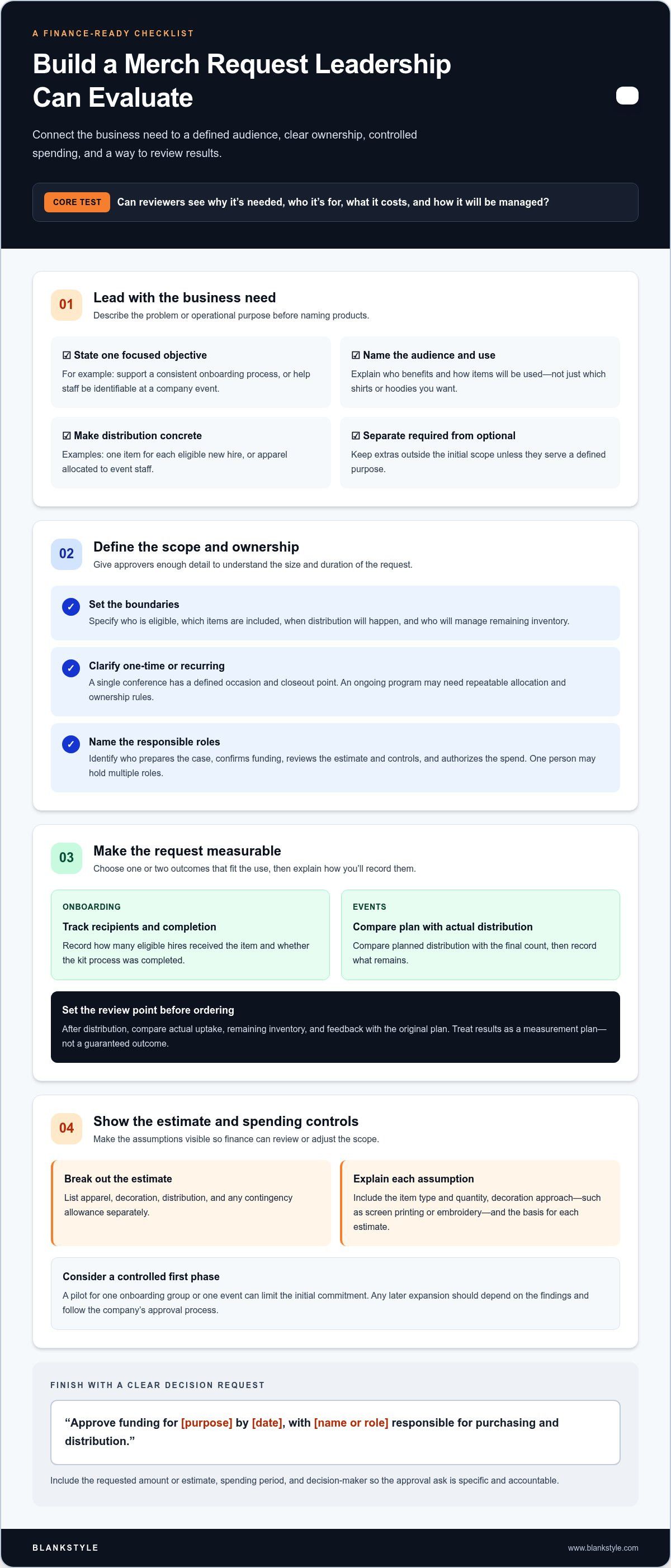
Getting company merchandise budget approval requires presenting a structured business case rather than a product list. Finance and leadership need to understand who owns the request, what business goal it supports, and how spending will stay controlled. This guide outlines how to build an approval-ready request, choose a funding model, and set practical spending limits.
Key points
- Merch requests fail when they lack a clear business purpose and defined audience. Without explaining who will use items and why, approvers cannot assess whether the purchase addresses a real need or justifies the expense.
- Start with the operational objective, not the product list. Name the specific problem first, such as "provide a consistent onboarding kit for new hires," then explain how distribution will work and who benefits.
- Map decision-makers and address their likely concerns directly. Identify the requester, budget owner, finance reviewer, and final approver, then answer questions about discretionary spending, inventory risk, and accountability upfront.
- Build the business case around narrow, measurable outcomes. "Support a consistent onboarding process" is easier to evaluate than "boost morale." Define what success looks like before ordering and present it as a measurement plan, not a guaranteed result.
- Choose a funding model that matches your program's frequency and team structure. Centralized funding suits occasional orders, department budgets offer local flexibility, and individual allowances provide recipient choice—each has trade-offs in oversight and reporting complexity.
- Use a five-step approval-ready request template covering objective, audience, quantity, assortment, estimate, owner, timeline, and controls. Keep the core decision and scope scannable for reviewers, separate known costs from assumptions, and define what happens if demand exceeds the approved limit.
Summarized by MalakyeAI