


HVAC Local Service Ads Management: 2026 Buying Guide
By Bullseye Marketing Consultants
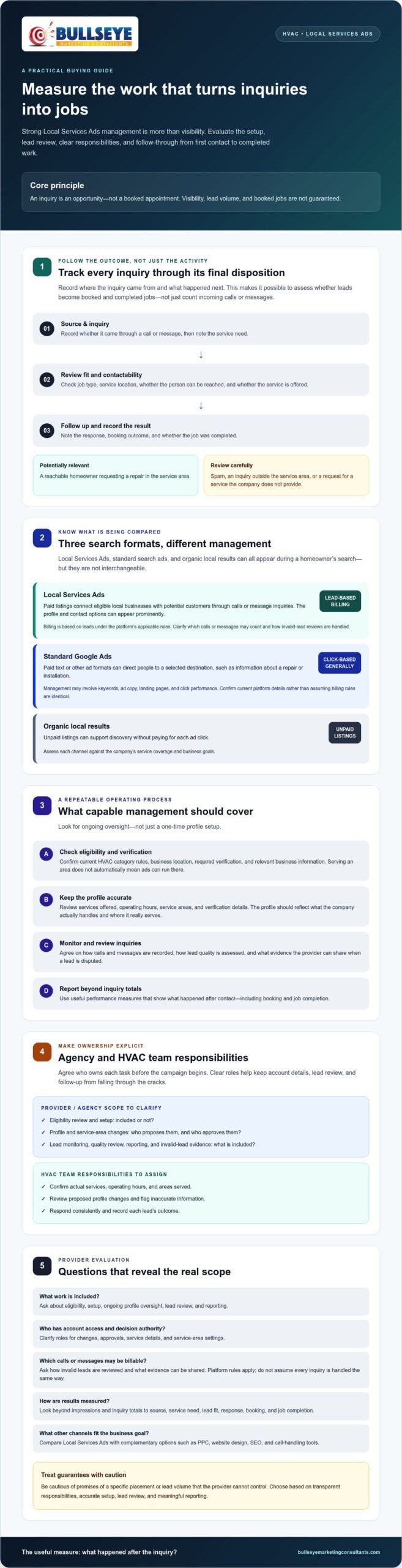
HVAC companies evaluating Local Services Ads management should prioritize work quality and job completion over inquiry volume and promised placement. The 2026 buying guide outlines how to assess provider responsibilities, lead tracking processes, and reporting transparency to connect ad inquiries with actual revenue. Choosing the right partner requires clear expectations about account access, performance measures, and each party's role.
Key points
- Local Services Ads charge per lead, not per click like standard Google search campaigns. Billing is based on qualified inquiries under Google's platform rules, which differ from traditional paid search and organic visibility models.
- Effective management requires a repeatable four-step cycle: verify eligibility and profile accuracy, monitor incoming calls and messages, qualify each lead by job type and location, then report outcomes. The provider and HVAC business must agree on who owns each task before the campaign starts.
- Lead quality depends on separating total inquiries from qualified opportunities, booked jobs, and completed work. According to the source, "the real measure of local service ads management isn't how many inquiries come in, but how many turn into completed jobs."
- HVAC contractors should build a reliable response process and track four details for each inquiry: source, service need, location, and disposition. Missed calls and slow follow-up reduce the likelihood of converting contacts into scheduled appointments.
- Red flags in provider proposals include guaranteed placement, unsupported promises about lead volume, vague explanations of billable leads, and account structures that prevent client access. A responsible provider should explain what it controls, what depends on Google, and what the HVAC team must handle.
- Service-area boundaries and coverage must reflect actual operating limits, not assumed regional demand. Companies serving Palm Beach Gardens or Miami should define and track outcomes by specific location rather than combining all South Florida leads into one total.
Summarized by MalakyeAI