


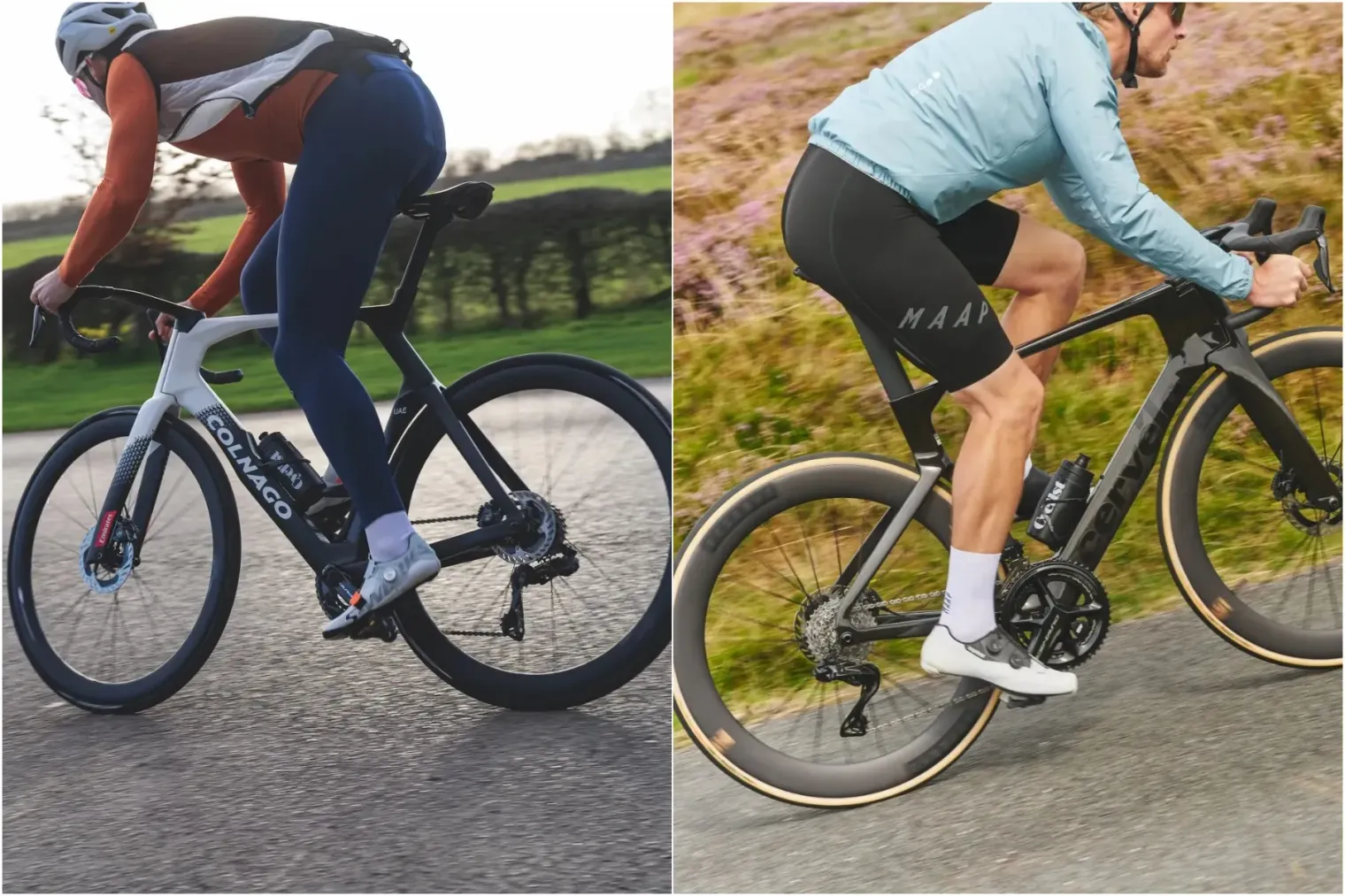
Tadej Pogačar and Jonas Vingegaard both experienced mixed 2026 seasons, winning major tours before suffering crashes that ended their campaigns. Both riders choose their respective brands' aerodynamic bikes—Pogačar rides the Colnago Y1Rs while Vingegaard prefers the Cervélo S5—over lighter climbing alternatives. This comparison examines the design, geometry, and performance specifications of these two WorldTour-level race machines.
Key points
- Both bikes feature radical aero frame designs targeting optimal performance at race speeds. The Y1Rs and S5 each employ bayonet fork mounts rather than internal steerers, allowing narrower head tubes and extended head tube areas for aerodynamic benefits, though this increases weight.
- Colnago claims the Y1Rs is 9 watts more aerodynamically efficient than unnamed competitors. The manufacturer states its refined CFD modelling achieves 15% divergence from wind tunnel results, compared to the typical 30% industry standard, and heavily hints the comparison is against the S5.
- The Colnago Y1Rs features a distinctive Y-shaped seat tube limiting seatpost adjustability to 15mm. Colnago's head of R&D noted that "since a seatpost is a relatively inexpensive component," this design constraint poses minimal practical disadvantage.
- Cervélo's S5 represents the fifth generation of a bike platform dating to 2011. Recent updates include a deepened head tube and fork legs with aero optimization for 29mm tyres instead of the previous 26mm width.
- Both bikes share nearly identical geometry within millimetres across most dimensions. The primary exception is the Colnago's head tube, which measures 25.5mm longer on compared sizes, though overall frame stack remains similar.
- Complete bike weights are competitive despite aero designs typically being heavier than climbing bikes. The Cervélo S5 claims 6.74kg in its lightest 1x SRAM Red AXS build, while tested Colnago Y1Rs examples weighed approximately 7.1kg with Dura-Ace groupsets.
Summarized by MalakyeAI