


Reforesting the Gran Chaco with Drones
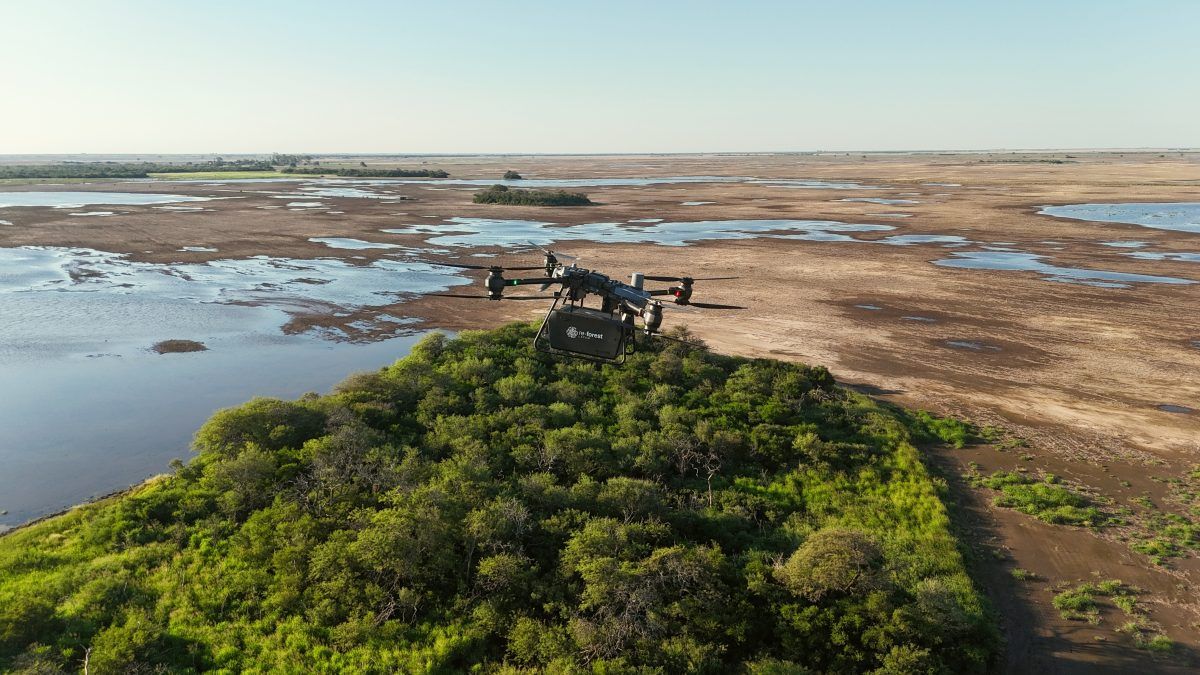
The Nature Conservancy Argentina is using drone technology to reforest the Gran Chaco, one of the world's most degraded regions. The initiative deploys biodegradable seed capsules containing native tree species across agricultural landscapes in Santa Fe and Santiago del Estero provinces. The pilot project aims to plant 8,000 native trees across 13 hectares using precision drones and biotechnology.
Key points
- Drone-assisted reforestation targets 100,000 trees in the Gran Chaco region. TNC Argentina partnered with ReForest Latam and the John Deere Foundation to restore degraded agricultural areas, with over 300 hectares already planted using traditional methods.
- Aerial seeding overcomes logistical challenges of manual tree planting. The technology reduces costs and allows restoration in hard-to-reach areas where traditional planting methods would be impractical or infeasible.
- Seeds are deployed in biodegradable capsules containing biostimulants. ReForest's iSeeds technology includes formulations designed to local genetics, with each capsule tailored to specific environmental conditions for improved germination and establishment.
- The Gran Chaco is vital yet severely deforested and degraded. According to Maia Plaza Behr, forest conservation specialist at TNC Argentina, "drone-assisted regeneration could be a key component" in scaling up restoration interventions.
- Native tree species are selected for ecological and climate adaptation. Primary species include white carob trees, yellow floss silk trees, guayacán, and Santiago red quebracho, chosen for their natural suitability to local conditions and role in ecosystem recovery.
- Control plots monitor success over 120 days post-dispersal. Researchers assess germination rates and seedling establishment by comparing treated and untreated areas, with landowner Mariano Fiori noting he wants to "pass this legacy on to my children and future grandchildren."
Summarized by MalakyeAI