


Getting Seen: Ways to Make It Happen

TL;DR
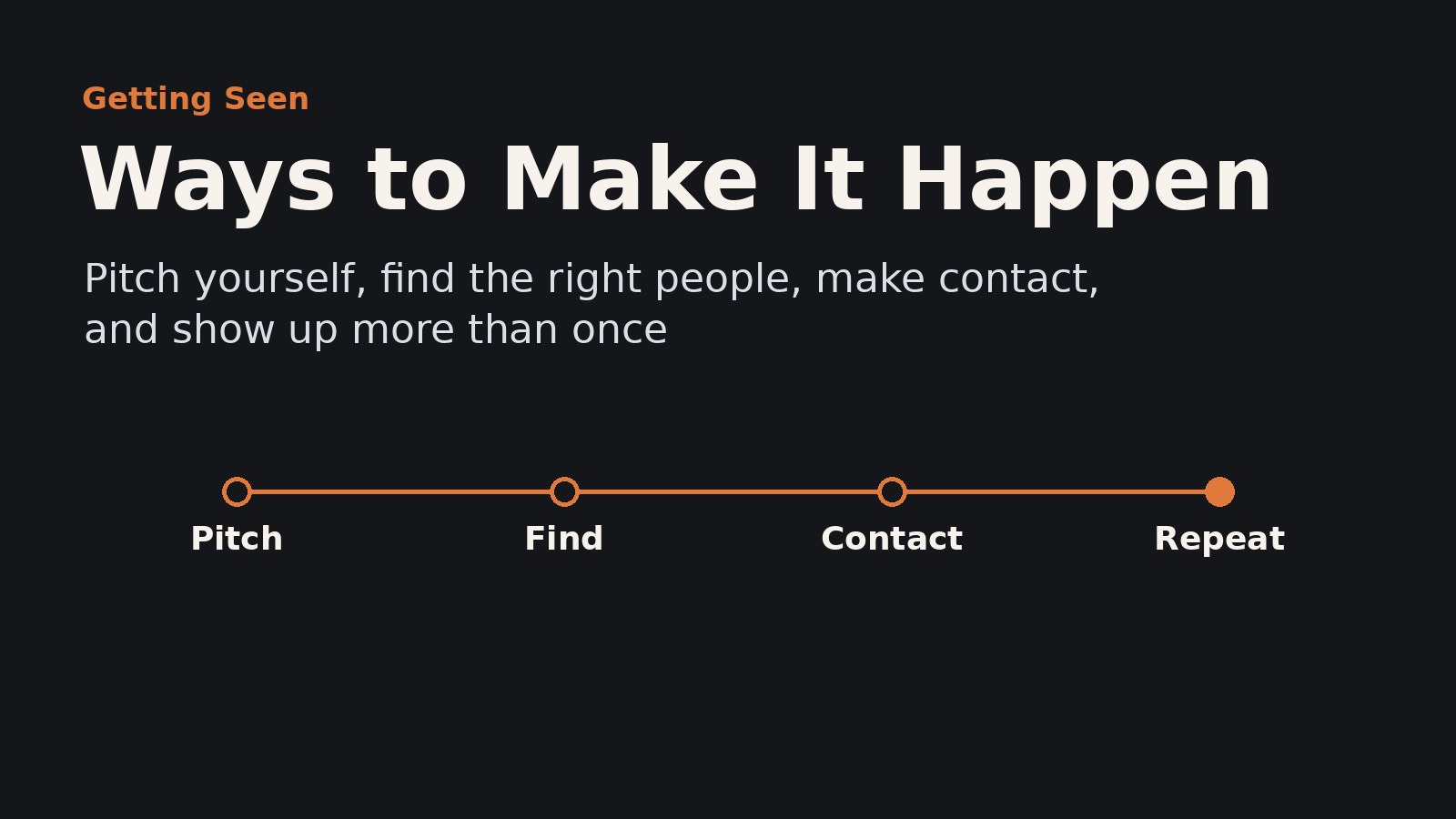
Hitting "apply" puts you in a pile. Getting seen puts you in the conversation. Here's how to pitch yourself, who to find, how to reach them, and why it works. The whole article in 4 moves 1 Pitch yourself - know the two sentences that make you the obvious fit. 2 Find the right people - the person hiring, and one person doing the job.
Hitting "apply" puts you in a pile. Getting seen puts you in the conversation. Here's how to pitch yourself, who to find, how to reach them, and why it works.
Pitch yourself before anyone asks
Most people can't say in one breath why they're right for a job. The ones who get seen can. Before you reach out to anyone, write your pitch: who you are, the one or two results that match what this brand needs, and why you want to be there. If it doesn't fit in two sentences, it isn't sharp enough yet.
Make it specific to the job. If the posting talks about opening new accounts, say how many you opened and where. If it mentions product launches, name the ones you shipped. Then add one honest line about why this brand. That last line is the one most people skip, and it's the one that sticks.
Who to find
You're looking for two people, and neither has to be a close friend.
The person hiring. That's the hiring manager or the recruiter running the search. Check the job post first. Many name the person behind it. If not, look up the brand, see who leads the team the job sits on, and start there.
One person doing the job, or sitting next to it. A peer can tell you what the team actually needs, and what the posting leaves out. They're often the easiest person to reach, and their opinion carries weight when your name comes up.
On Malakye you can look up any brand, see who works there, and message them directly. The People Network Cheat Code walks through it step by step, and the company hit-list helps you decide which brands are worth the effort.
Why a person beats a pile
A connection inside the company doesn't guarantee a job. What it does is make sure a real person looks at you. The people who hire for a living say exactly that.
"I would say no, they don't increase the odds of getting a job, but they do increase the odds of getting a CV actually seen. However, if an employee has referred someone, then that CV always gets looked at and vetted."Jonathan Duarte, founder and CEO, GoHire, in Jobvite
Jobvite reported that employee referrals make up only about 7 percent of candidates, but convert at nearly 40 percent (Jobvite). Another hiring lead told Jobvite that referrals "actually get hired 10X more often than candidates that apply for a job ad," partly because "in many cases, all referral resumes are reviewed, which isn't the case for other candidates" (Bogdan Zlatkov, Growth Hack Your Career, in Jobvite).
That's the whole point. You don't need a favor. You need one real conversation that puts your name in front of someone before they make a shortlist.
How to make contact
Keep the first message short enough to answer from a phone. Say who you are, why you're reaching out to them specifically, the one thing you bring, and a small, easy ask. A 15-minute call or one question about the team is easy to say yes to. "Can you get me a job" isn't.
If you've already applied, say so, and say why you fit in one line. If you haven't, ask what the team is really looking for, then use the answer in your application. Either way, you've just become a name instead of a file. The one-message formula breaks down exactly what to write, and Connecting with Intent shows how to make it worth their time.
Show up more than once (but not too often)
There's a reason brands run the same ad more than once. In 1968, psychologist Robert Zajonc showed that people grow to like things simply by seeing them more often. It's called the mere exposure effect. The research also shows the limit: liking climbs fastest over the first few exposures, then levels off, and too much repetition starts to work against you (The Decision Lab).
So plan a few well-spaced touches, not a flood. Your application is one. A note to the hiring contact is two. A thoughtful comment on something the brand shared is three. A short follow-up a week or two later is four. By then your name is familiar, and familiar feels safe to someone choosing between finalists.
It works: proof from the network
Kyle Shields found a softgoods design job at PING on Malakye, applied through Malakye, and moved from Seattle to Phoenix to take it. He beat the hardest bias in hiring, the relocation hire, by making his fit impossible to miss. And in These 3 Found the Yellow Brick Road, three members went from retail floors to specialist jobs at Specialized, Mountain Hardwear and Roxy. None of them got there by waiting to be noticed.
Pick the three jobs you want most, find them on Malakye, and run the play.
Sources
Jobvite - 4 Reasons to Invest in Employee Referrals (2019) · Jobvite - Do Employee Referrals Guarantee Interviews? (2023) · The Decision Lab - Mere Exposure Effect