


How to Prevent Screen Prints from Cracking: A Practical Guide
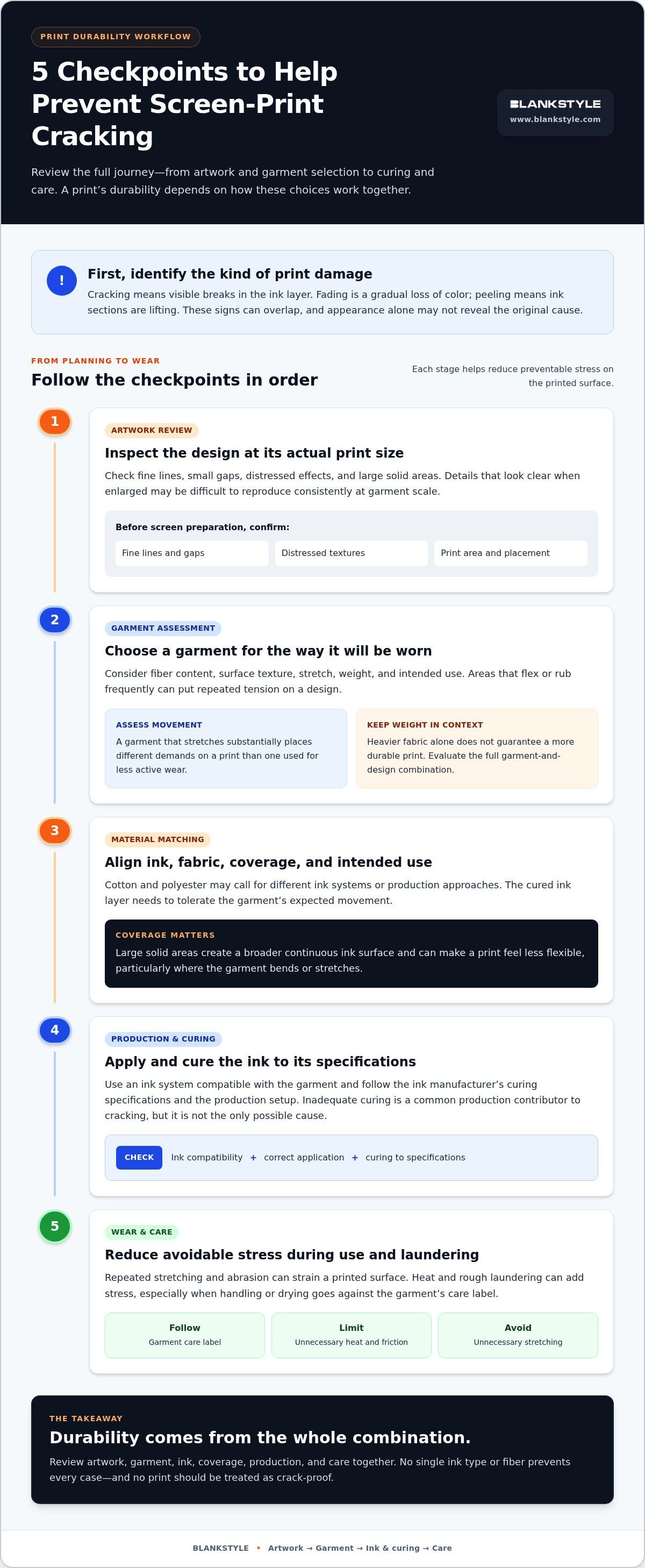
Screen-print cracking results from multiple interacting factors beyond washing alone, including ink curing, print thickness, artwork design, fabric stretch, and garment quality. Identifying the root cause helps prevent repeating the same problem in future orders. A comprehensive approach addressing artwork preparation, ink selection, curing standards, and proper aftercare can significantly reduce preventable wear.
Key points
- Screen-print cracking involves visible splits or ink loss from combined stress factors. The appearance helps narrow down causes, but "cracking is visible splitting or loss of continuity in a printed ink layer" that develops when production choices, garment properties, and use combine to stress the print.
- Ink-film flexibility, garment movement, and print coverage all affect print durability. A stiff ink layer may experience more stress as fabric bends, while stretchy garments and high-movement areas place repeated tension on designs, making placement and artwork choice critical planning steps.
- Artwork must be reviewed at actual print size before screen preparation begins. Fine lines and small gaps that appear clear on a monitor may be difficult to reproduce at garment scale, and large solid areas can make prints feel less flexible in areas where garments bend.
- Ink system selection and consistent application are essential production controls. Matching the ink to garment material, applying controlled coverage, and following "the ink manufacturer's technical guidance for the ink and production setup" ensures the print responds appropriately to the garment's expected movement.
- Proper curing according to ink supplier specifications prevents common production failures. Undercuring can compromise print performance, so equipment, ink formulation, and production conditions should be recorded and reviewed when setups change rather than assuming earlier settings will transfer unchanged.
- Aftercare routines reduce avoidable stress through gentler washing, inside-out drying, and careful wear practices. Turning garments inside out before washing, following care-label instructions, and avoiding repeated stretching across printed areas limits friction and heat damage, though good care cannot repair production problems.
Summarized by MalakyeAI