


Ringspun Cotton vs. Regular Cotton for Printing: Which Should You Choose?
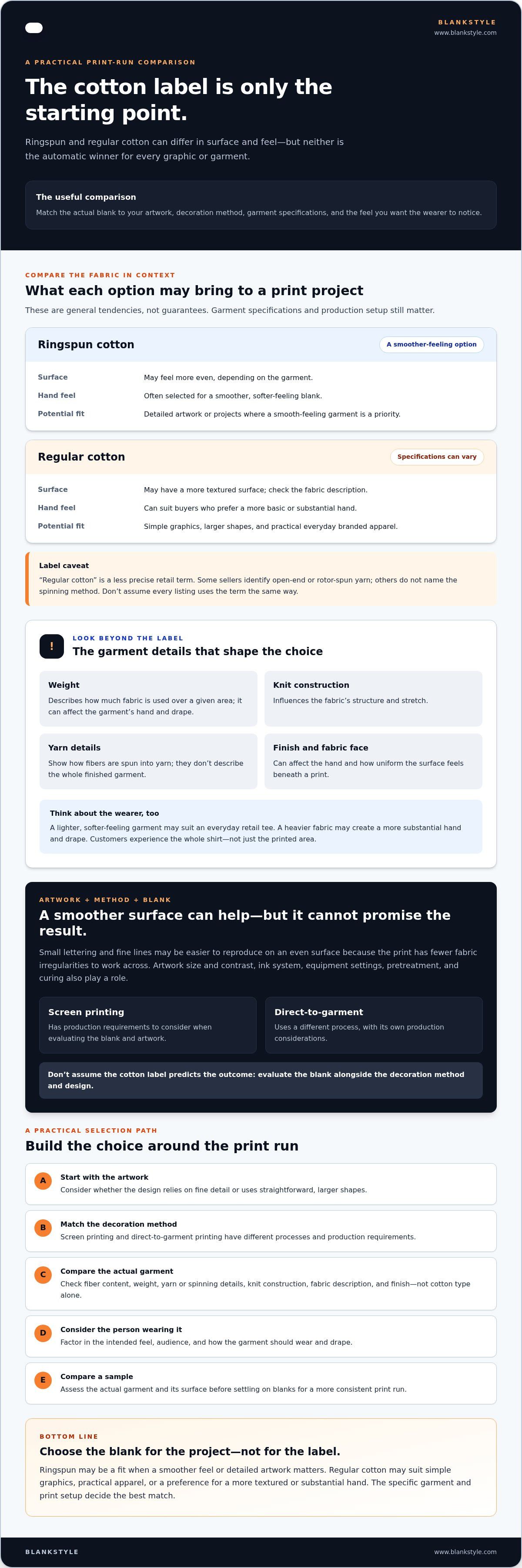
Ringspun and regular cotton each suit different printing projects, and the choice depends on artwork, decoration method, and desired garment feel rather than fabric type alone. Ringspun yarn may create a smoother surface useful for detailed graphics, while regular cotton works well for simpler designs and cost-conscious orders. Testing a sample with your intended artwork and process before scaling up helps ensure consistency and quality.
Key points
- Ringspun yarn is made through a different spinning process than regular cotton. Ringspun fibers are continuously drawn, thinned, and twisted, while conventional yarn uses a rotor method, creating potential differences in yarn surface and fabric characteristics.
- "Regular cotton" is a broad retail term without precise spinning-method definition. Labels like "ringspun" describe yarn construction, not complete garment specifications including weight, knit construction, or finish.
- Ringspun may provide a smoother fabric surface suited for detailed artwork. "Small lettering and fine lines may be easier to reproduce on an even surface because the print has fewer fabric irregularities to work across."
- Smooth fabric surface alone does not guarantee superior print quality. Artwork size, contrast, ink system, pretreatment, equipment settings, and curing all influence how detail appears in the finished print.
- Regular cotton can be practical for straightforward graphics and budget-conscious projects. Simple, bold designs and larger shapes often print successfully on conventional cotton blanks when garment specifications match the decoration method.
- Sample testing with intended artwork and production process is essential before bulk orders. "Print the actual artwork on the selected blank using the intended decoration process before scaling up" to assess appearance, hand feel, and consistency across the full run.
Summarized by MalakyeAI