


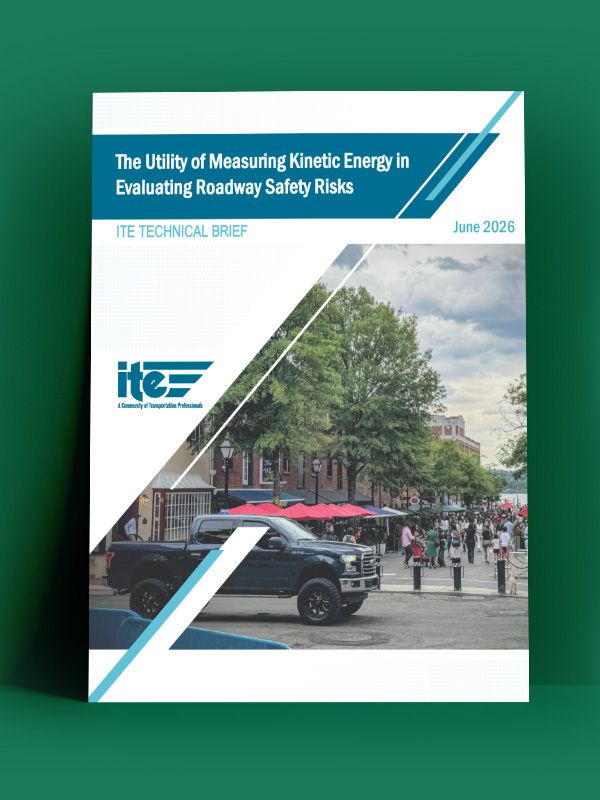
A new technical brief examines how kinetic energy analysis can improve street safety evaluation before severe crashes occur. The approach evaluates roadway risks by measuring crash injury exposure, likelihood, and severity across intersections, corridors, and regional networks. This proactive method identifies dangerous conditions even where crash history appears minimal.
Key points
- Kinetic energy helps identify safety risks before crash patterns emerge. Streets with minimal crash histories may still pose serious harm potential that practitioners can detect through kinetic energy analysis.
- A new ITE technical brief provides practical implementation guidance. "The Utility of Measuring Kinetic Energy in Evaluating Roadway Safety Risks" brings together methods and tools for applying this safety measure at multiple scales.
- The Safety Multipliers framework examines how exposure, likelihood, and severity interact. This existing framework helps practitioners understand how these factors combine to shape overall roadway risk.
- Street Energy is a developing tool that maps vehicle movement intensity. The tool combines traffic volume, vehicle mass, and speed to show where movement intensity may not align with surrounding context.
- The approach represents a shift in safety thinking. Rather than asking only "where have severe crashes happened," practitioners now also ask "where conditions for serious harm may already exist."
- Multiple scales of analysis are supported. The framework applies to individual intersections, corridors, and entire regional networks for comprehensive safety evaluation.
Summarized by MalakyeAI