


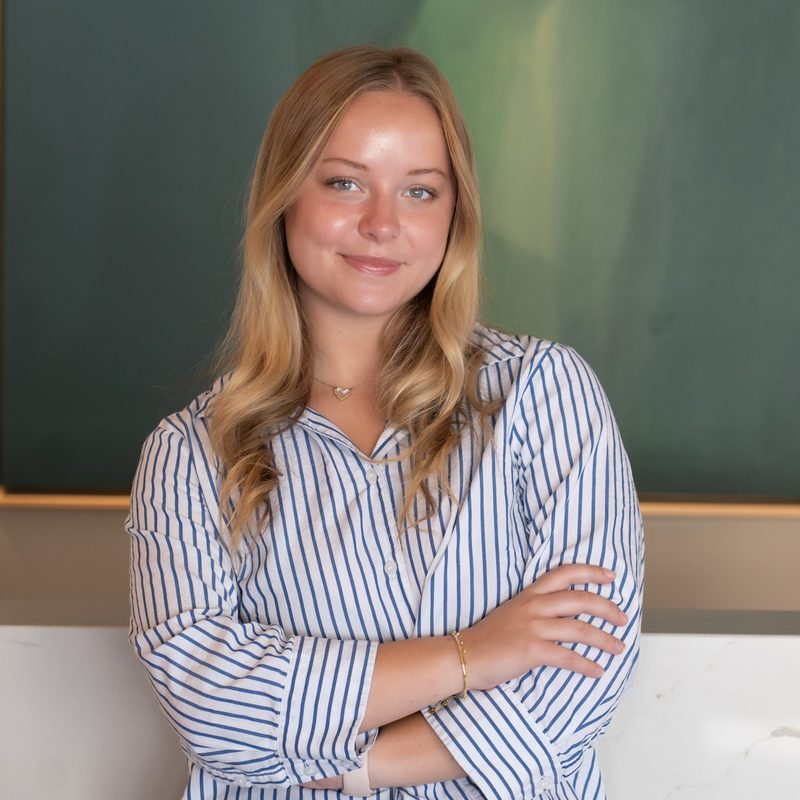

In My Own Words
Marketing professional with 4 internships across PR, luxury travel, defense, and real estate. Currently at J Public Relations, developing social strategy for high-profile clients in the luxury travel space, working across content calendars, Meta advertising, influencer marketing, and performance reporting. Fluent in English and French.
I'm drawn to the intersection of data and creativity, using analytics to shape campaigns that are both strategic and compelling. Across my internships, I've grown engagement, managed $30K+ event budgets, and built content systems from the ground up. Experienced with Meta Ads, Sprout Social, HeyOrca, Canva, Adobe Photoshop, Adobe Premiere Pro, Salesforce, and Excel.
Graduating from SDSU's Fowler College of Business in May 2026 with a B.S. in Marketing and a minor in French. Open to full-time roles in marketing and social strategy.
Work Experience
Swim Instructor
Jackie Robinson Family YMCA2025 – Present
Social Media Intern
J/PR2025 – Present
Marketing and Operations Intern
Lewis Defense, LLC2025 – 2025
PR and Social Media Intern
J/PR2025 – 2025
Social Media Marketing Intern
Schwarz Real Estate Group2025 – 2025
Marketing Intern
BrandMunki Inc.2020 – 2020
Education
Gallatin Valley Community College
2019 – 2021
Dual Enrollment Coursed with High School
Bachelor's degree
San Diego State University2022 – 2026
Bozeman High School
2018 – 2022
Projects
Measuring Fowler Business Students AI Aptitude and
This study investigates the gap between perceived and actual AI competency among undergraduate students at the Fowler College of Business (FCB) at San Diego State University. As AI becomes increasingly embedded in business operations, a critical question emerges: are business students genuinely prepared to work in AI-integrated environments, or are they simply confident that they are? Existing measures of AI literacy rely predominantly on self-reported confidence and are rooted in academic or K–12 contexts, offering little insight into business-specific AI aptitude. This project addresses that gap by developing and deploying a validated, objective assessment instrument tailored specifically to business applications. The instrument measures student competency across nine subdomains organized into four categories: Techniques & Applications (prompt engineering, custom GPT deployment), Security & Responsibility (data privacy, ethical risk awareness), Discernment of Appropriate Usage (task suitability, human vs. AI boundaries), and Critical Judgment of Output (hallucination recognition, bias detection). The survey will be administered to approximately 400 FCB students across majors, class levels, and concentrations. Analysis will include descriptive statistics, confidence gap analysis, K-means clustering to identify distinct AI aptitude profiles, and cross-major subdomain comparisons. Findings will be reported to FCB faculty and administrators to inform evidence-based curriculum decisions — helping ensure Fowler graduates are not only confident in using AI, but genuinely competent in applying it within real-world business contexts.
Second Course Marketing Strategy | MKTG 494 Capsto
For my capstone marketing course at SDSU, I had the opportunity to develop a real-world marketing strategy for Second Course, a campus app designed to connect students with leftover food from campus events. Our team began by conducting primary research, distributing surveys across business and elective classes and gathering live feedback from fellow students via QR code sign-up campaigns. Early responses revealed something counterintuitive: positioning the app around food insecurity was actually deterring potential users. Students associated that framing with stigma, and our data confirmed it — embarrassment showed a significant negative correlation with likelihood of claiming food. This required a full strategic pivot. Using our survey findings, I applied core STP (Segmentation, Targeting, Positioning) principles to reframe the entire value proposition. Rather than marketing Second Course as a resource for students in financial need, I recommended repositioning around sustainability and social engagement — shifting messaging from "Free Food for Students in Need" to "Save Campus Food from the Dumpster." The revised strategy included two positioning tracks: a Sustainability Positioning targeting climate-conscious students through a potential partnership with the SDSU Sustainability Office, and a Social Positioning that reframed the app as an insider perk for engaged campus participants — partnering with Associated Students and major clubs to make Second Course the go-to channel for sharing event leftovers. This project sharpened my skills in consumer research, data interpretation, strategic repositioning, and client-facing recommendations. Most importantly, it taught me that adaptability is a core marketing competency — the ability to read real data, challenge your assumptions, and adjust your strategy is what separates good marketers from great ones.