


What Is Garment-Dyed Fabric? How the Process Changes a Garment
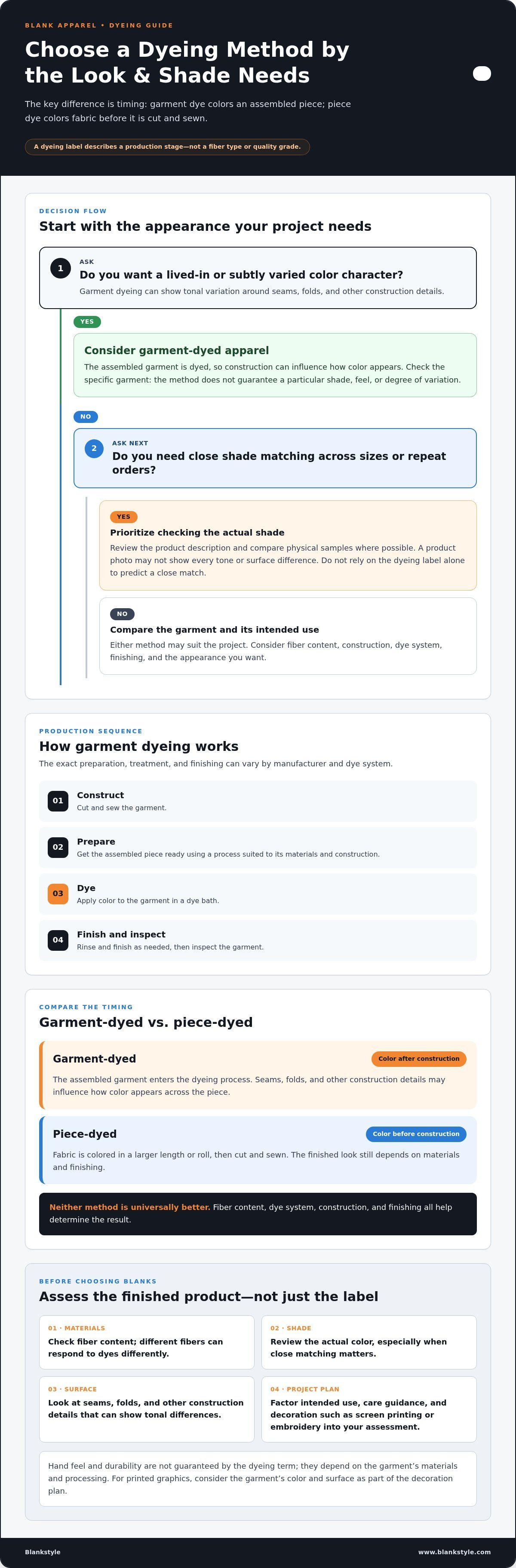
Garment dyeing applies color to finished, assembled garments rather than to fabric before cutting and sewing. This timing difference affects how color settles around seams, folds, and construction details, creating a potentially softer hand and lived-in appearance. The method doesn't guarantee uniform shade across garments, making it distinct from piece dyeing in both process and final result.
Key points
- Garment dyeing occurs after the garment is fully constructed. The assembled piece is placed in a dye bath, distinguishing this method from coloring fabric earlier in production.
- The dyeing term describes production timing, not fiber type or quality. Garment-dyed items can be made from different fibers, and their feel and durability depend on materials and processing choices.
- Construction details influence visible color variation. Seams, folds, hems, and stitched areas may show color differently from flat panels, contributing to a "lived-in or dimensional look."
- Garment dyeing differs fundamentally from piece dyeing in application stage. With piece dyeing, "fabric is colored in a larger length or roll, then cut and sewn," while garment dyeing introduces color to the finished piece.
- Shade consistency cannot be guaranteed across garments or reorders. Fiber content, dye chemistry, and construction all influence results, so buyers should compare physical samples and keep reference garments for future orders.
- Decoration and care depend on the specific garment's specifications. Screen printing results and washing instructions vary by fiber, construction, and dye system, requiring evaluation before production rather than relying on the dyeing label alone.
Summarized by MalakyeAI