


Complexity Has a Balance Sheet: The Hidden Cost of Product Variety in RuleStream Environments
By Pratiti - Crafting Digital Journeys
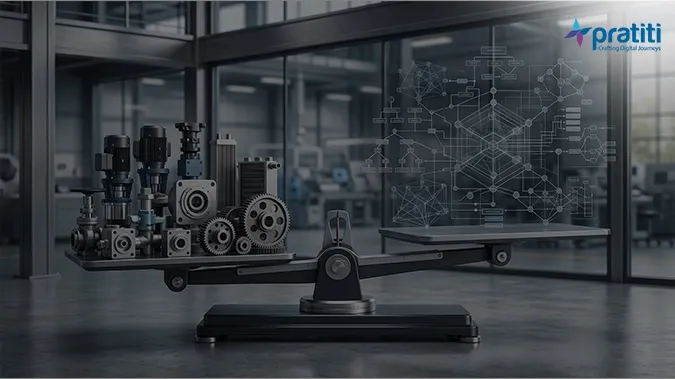
Manufacturing leaders often overlook the true cost of product variety, which scatters across engineering, procurement, testing, and service rather than appearing as a single budget line. A single customer request for one additional option typically triggers cascading work across multiple departments, making complexity costs invisible despite their cumulative impact. Understanding and measuring these hidden costs becomes critical as manufacturers invest in connected operations and data-driven engineering.
Key points
- Product variety costs hide across departments instead of appearing on balance sheets. When a customer requests a corrosion-resistant material, the expense spreads through supplier qualification, design rule updates, validation testing, documentation revision, and service procedures rather than showing as one identifiable cost.
- Complexity capital represents an organization's capacity to support product options through reusable engineering knowledge. Two manufacturers selling equally customized equipment can have vastly different complexity costs depending on whether they draw from existing engineering rules or rebuild solutions from scratch each time.
- Five operational metrics reveal whether a new configuration adds genuine value. Rule reuse rate, variant maintenance load, supplier expansion ratio, validation multiplier, and documentation footprint provide measurable indicators of complexity impact when tracked together across configuration decisions.
- Downstream teams absorb most product variety costs long after engineering decisions are made. Procurement manages new supply chains, quality teams multiply validation scenarios through variant combinations, and field service carries configuration complexity years after production ends, yet no single department budget captures the total impact.
- Connected engineering systems make complexity costs visible and traceable. When RuleStream integrates with PLM, ERP, CAD, and documentation systems, a single configuration links to its bill of materials, supplier impact, compliance requirements, and service records, forming "one connected thread instead of five disconnected departmental workflows."
- Manufacturers should evaluate product variety as an investment decision, not just a technical capability. The critical question shifts from whether a configuration is technically possible to "what this configuration will actually cost the organisation, and how much of that cost can existing engineering knowledge absorb."
Summarized by MalakyeAI