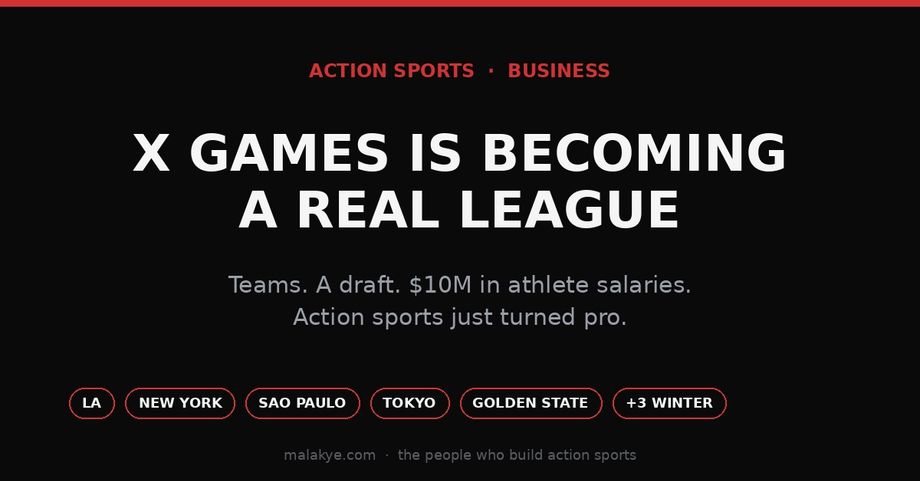
Information Leak On August 4, 2026, X Games sold another team. An investment group led by entrepreneur Jonathan Turner bought the winter club that will compete as X Games Club Golden State, the sixth of eight franchises the league has now placed with private owners. It will make the first pick in the inaugural winter draft on September 16 in Los Angeles, ahead of a winter season that launches in 2027. On its own, a club sale is a business footnote. Together with everything around it, it is the clearest signal yet that action sports just quietly turned into a real professional league, with teams, a draft, and something the sport has never truly had: salaries. If you make your living in this industry, or want to, this is the most important structural change in action sports in a generation. Here is what actually happened, and why it matters far beyond the podium. From a broadcast to a league For most of its life, X Games was a television event. It was born at ESPN in the mid 1990s, and for almost three decades it worked the way every action sports contest worked. Athletes showed up, competed as individuals, won a medal and a check, and went home to chase the next sponsor and the next contest. There was no team, no season, no salary, and no floor under anyone's income. In 2026 that model was torn up. Under CEO Jeremy Bloom, X Games launched the MoonPay X Games League, the first team-based, co-ed action sports league in the world. Eight clubs, four summer and four winter, each owned like a real sports franchise. The summer clubs are XC Los Angeles, XC New York, XC Sao Paulo, and XC Tokyo. The winter side is filling in now, and Golden State is the newest piece. Each club fields ten athletes, five men and five women, chosen by a club general manager. There is a season, a points race, and a championship. It looks less like a contest and more like the NBA. The part that changes everything: athletes get paid Here is the number that matters. Every athlete drafted into a club receives a guaranteed base of thirty thousand dollars, regardless of where they are picked, plus travel benefits and performance incentives on top. The league committed ten million dollars in athlete spend, five million to summer and five million to winter. The club that wins the championship competes for a five hundred thousand dollar purse. Read that again, because in action sports it is close to revolutionary. For thirty years the deal was simple and brutal. You were only worth your last result, and if you got hurt or slumped, the money vanished. A guaranteed salary and benefits change the math of an entire career. Bloom did not undersell it. He called the ten million dollar athlete spend "probably the biggest number that has ever existed in action sports," and said the league finally gives the sport a way to "treat these athletes like real professionals." That is the whole story in one sentence. The draft is real, and so are the picks This is not a marketing exercise with a fancy name. The first XGL draft happened on March 12, 2026. More than one hundred and eighty athletes opted in, and forty were selected across the four summer clubs through a snake draft run by real general managers. XC New York took sixteen year old Australian skateboard phenom Chloe Covell with the number one pick. XC Los Angeles took Tom Schaar, a seventeen time X Games skateboard medalist. Now the winter side runs its own draft on September 16, with Golden State on the clock first. Drafts, GMs, rosters, salaries, a season. Strip the branding and you are looking at the machinery of professional sports being bolted onto skateboarding,
Malakye Editor
Aug. 4, 2026 · 5 min read